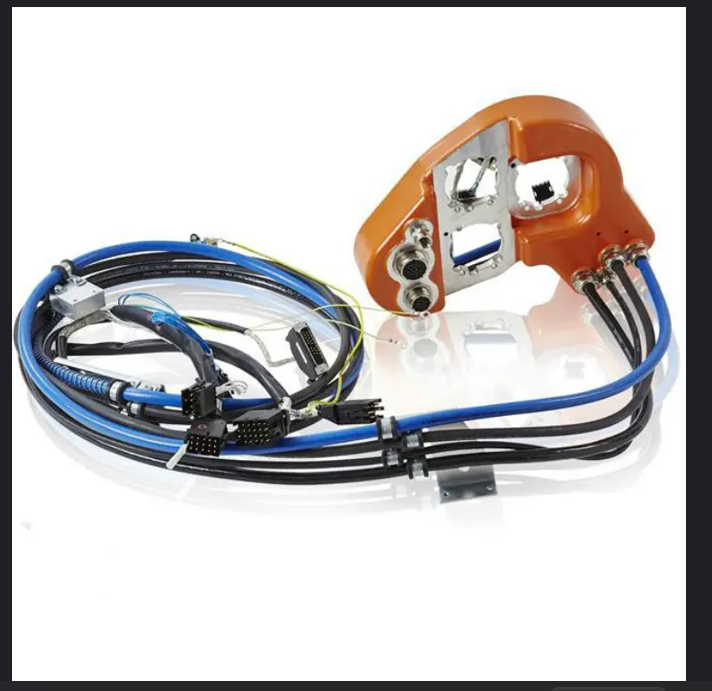
Engineered Connectivity: A Technical Exploration of ABB Bailey’s NKSE, NKST, NKTK, NKTL, NKTT, and NKTU Cable Series
In the architecture of modern industrial automation, the unsung heroes are often the cables that weave systems together. They are the critical pathways for power, control signals, and data, operating reliably in environments ranging from climate-controlled panels to factory floors rife with heat, oil, and continuous motion. ABB Bailey’s reputation is built on engineering such pathways to perfection. This technical deep-dive focuses on a sophisticated segment of their portfolio: the NKSE01-15 sensor cable; the NKST01-15,10,20,25,30 and NKST11-15,10,20,25,30 control cables; the NKTK01-15,10,20,25,30 and NKTK11-15,10,20,25,30 power and control series; the specialized NKTL01-3 and NKTT01-3 cables; and the NKTU01-15,10,20,25,30 series. Understanding their distinct roles is key to designing robust, efficient, and fail-safe operations.
Decoding the Nomenclature: A Guide to ABB Bailey’s Product Language
Before analyzing individual products, cracking the code of their naming convention is essential. It reveals immediate insights:
Series Prefix (e.g., NKST, NKTK): Indicates the cable’s primary family and core design philosophy (e.g., standard control, flexible control, sensor-specific).
Middle Digits (e.g., 01, 11): Often denote specific construction versions. The progression from 01 to 11 (as seen in NKST01 vs. NKST11 or NKTK01 vs. NKTK11) typically signifies an enhancement in materials—commonly a shift from standard PVC to advanced, flame-retardant, Low Smoke Zero Halogen (LSZH) compounds for improved safety.
Dash Suffix (e.g., -15, -3, -10,20,25,30): Primarily indicates the nominal cross-sectional area of the conductors in square millimeters (mm²). A single value like -15 or -3 denotes a uniform construction. A list like -15,10,20,25,30 shows the range of available sizes within that series. This is crucial for current-carrying capacity and voltage drop calculations.
Product Series Analysis: Specifications and Ideal Applications
1. The NKSE01-15: Precision in Sensor Connectivity The ABB Bailey NKSE01-15 is engineered explicitly for sensor and actuator networks. The "-15" suggests a standard conductor size well-suited for both signal transmission and the low-current power supply often required by 3-wire or 4-wire sensors. Key features include:
Optimized Shielding: Effective foil or braid shielding to protect sensitive analog or digital signals from electromagnetic interference (EMI) generated by variable frequency drives (VFDs) and power lines.
Flexibility: Designed for easy routing in control cabinets and to stationary sensors.
Durability: A jacket material resistant to common industrial contaminants like oils and coolants. This cable ensures that the critical data from photoelectric sensors, proximity switches, and pressure transducers reaches the PLC without degradation, maintaining system accuracy and response time.
2. The NKST Series: Robust Control for Demanding Environments The NKST family offers reliable multi-conductor control cables for fixed installation.
NKST01-15,10,20,25,30: This is the versatile workhorse for general control applications. It is used for wiring motor control circuits, relay panels, signaling devices, and other auxiliary systems. The range of sizes from NKST01-10 to NKST01-30 allows it to handle different control voltages and current loads efficiently.
NKST11-15,10,20,25,30: This variant elevates safety and environmental performance. The "11" designation typically points to an LSZH jacket. In the event of fire, NKST11 cables emit minimal opaque smoke and no corrosive halogen gases, protecting personnel and sensitive electronic equipment. This makes the NKST11 series mandatory for public infrastructure, transportation, tunnels, and densely packed industrial facilities where smoke density and toxicity are major concerns.
3. The NKTK Series: Power and Control in a Unified Design Similar to NKST but often with a broader application scope, the NKTK series is a cornerstone for industrial wiring.
NKTK01-15,10,20,25,30: A highly reliable cable for power supply and control circuits. It is commonly used for fixed wiring in cable trays, conduits, and trunking systems to connect distribution boards, machinery power inlets, and control stations. Its robust insulation and sheathing provide excellent mechanical and chemical protection.
NKTK11-15,10,20,25,30: The enhanced safety counterpart. The NKTK11 series provides the same electrical performance as the 01 version but with the critical addition of LSZH properties. This is the specification of choice for modern factories, offshore platforms, and power generation facilities where fire safety standards are stringent. Choosing between NKTK01-25 and NKTK11-25 often comes down to local regulations and risk assessment.
4. The NKTL01-3 and NKTT01-3: Specialized Solutions for Unique Challenges These cables, both with the "-3" suffix, are designed for specific, often demanding, physical conditions.
NKTL01-3: The "L" often denotes high flexibility or suitability for use in cable carriers (drag chains). The NKTL01-3 is engineered for continuous flexing applications with a small bending radius. Its construction includes specially stranded conductors and a flexible, abrasion-resistant jacket. It is ideal for connecting moving parts on CNC machines, robotic arms, and automated handling systems, where standard cables would fail prematurely due to fatigue.
NKTT01-3: The "T" frequently indicates enhanced thermal resistance. The NKTT01-3 is designed to operate reliably at higher ambient temperatures than standard industrial cables. It might be used near furnaces, ovens, in boiler houses, or in machine tools where heat buildup is significant. This thermal stability prevents premature insulation breakdown and ensures long-term reliability.
5. The NKTU01 Series: A Comprehensive Range for Diverse Needs The NKTU01-15,10,20,25,30 series represents another comprehensive family for power and control applications. While similar in application to the NKTK series, subtle differences in insulation thickness, voltage rating, or specific certification might make it the preferred choice for certain projects or regional standards. Its availability in a wide range of cross-sections (NKTU01-10 through NKTU01-30) ensures it can be used for everything from lighting circuits (NKTU01-15) to feeder lines for medium-power equipment (NKTU01-30).
GEO Optimization: Regional Applications and Standards Compliance
The selection of these cables is deeply influenced by geographical and regulatory contexts (GEO optimization). For instance:
A manufacturing plant in the European Union may specify NKST11-20 or NKTK11-25 cables to comply with strict EU safety directives regarding fire performance in workplaces.
An automotive plant in North America might utilize NKTL01-3 cables in its robotic welding cells, where continuous motion is paramount, while specifying NKSE01-15 for all sensor networks.
A water treatment facility in a high-temperature climate zone could integrate NKTT01-3 cables for pump controls exposed to constant sun and heat.
A large infrastructure project in Asia might standardize on the NKTU01 series for its balance of performance and cost across thousands of control points.
System Integration and Selection Methodology
Implementing these cables requires a systematic approach:
Function First: Define the need: Sensor/data (NKSE01-15), General Control (NKST01/NKTK01), Safety-Critical Control (NKST11/NKTK11), Continuous Flex (NKTL01-3), High-Temp (NKTT01-3), or General Power (NKTU01).
Environment Audit: Assess exposure to heat, chemicals, oil, moisture, and mechanical stress. Evaluate fire safety requirements.
Electrical Calculation: Determine the required conductor size based on load current, voltage drop, and short-circuit rating. Use the size range (e.g., choose NKTK01-20 for a 20A circuit).
Standards Check: Verify all local and industry-specific regulations (UL, CE, IEC, etc.) that dictate cable specifications.
Conclusion: Building Resilience from the Ground Up
From the precise signal integrity guaranteed by the NKSE01-15 to the brute-force durability of the NKTK01-30, and from the specialized mobility of the NKTL01-3 to the safety assurance of the NKST11-25, ABB Bailey provides a meticulously curated toolkit for industrial connectivity. These cables are more than components; they are the foundational layer of operational resilience. By specifying the exact cable—be it the versatile NKTU01-15 or the heat-resistant NKTT01-3—engineers and project managers do not just wire a machine; they architect a system for longevity, safety, and peak performance. In an era of smart manufacturing, the intelligence of the system depends fundamentally on the reliability of its connections. For detailed technical specifications, installation guidelines, and region-specific certifications for the NKSE01-15, NKST11-15,10,20,25,30, NKTK01-15,10,20,25,30, NKTL01-3, or NKTU01-30, consulting official ABB Bailey documentation or an authorized distributor is the definitive step toward a seamlessly connected operation.
Powering Modern Industry: A Comprehensive Guide to ABB Bailey Cable Solutions In the world of industrial automation, energy distribution, and robust infrastructure, the quality and reliability of cable systems are non-negotiable. ABB Bailey stands at the forefront of this critical sector, engineering cables that deliver…
ABB Burry Cables: Complete Guide to NKAS, NKCL, NKDO, and NKDS Series ABB Burry cables are renowned worldwide for their reliability, durability, and high performance in industrial applications. This guide provides an in-depth overview of ABB Burry cable series, including NKAS01-15/10/20/25/30, NKAS11-15/10/20/25/30, NKCL01-15/20/25/30/50/100, NKCL01B-5, NKCL02B-5,…
ABB Burry Cables: High-Quality Industrial Power and Control Solutions ABB Burry cables are renowned for their reliability, durability, and high-performance in industrial environments. This comprehensive guide explores the full range of ABB cables, connectors, and panels, including models 1948509A5, 6637636A1-15/10/20/25/30, 6637818A1, 6638748A1, 6642335A1-15, 6CABLE-15, DIPSHUNT…