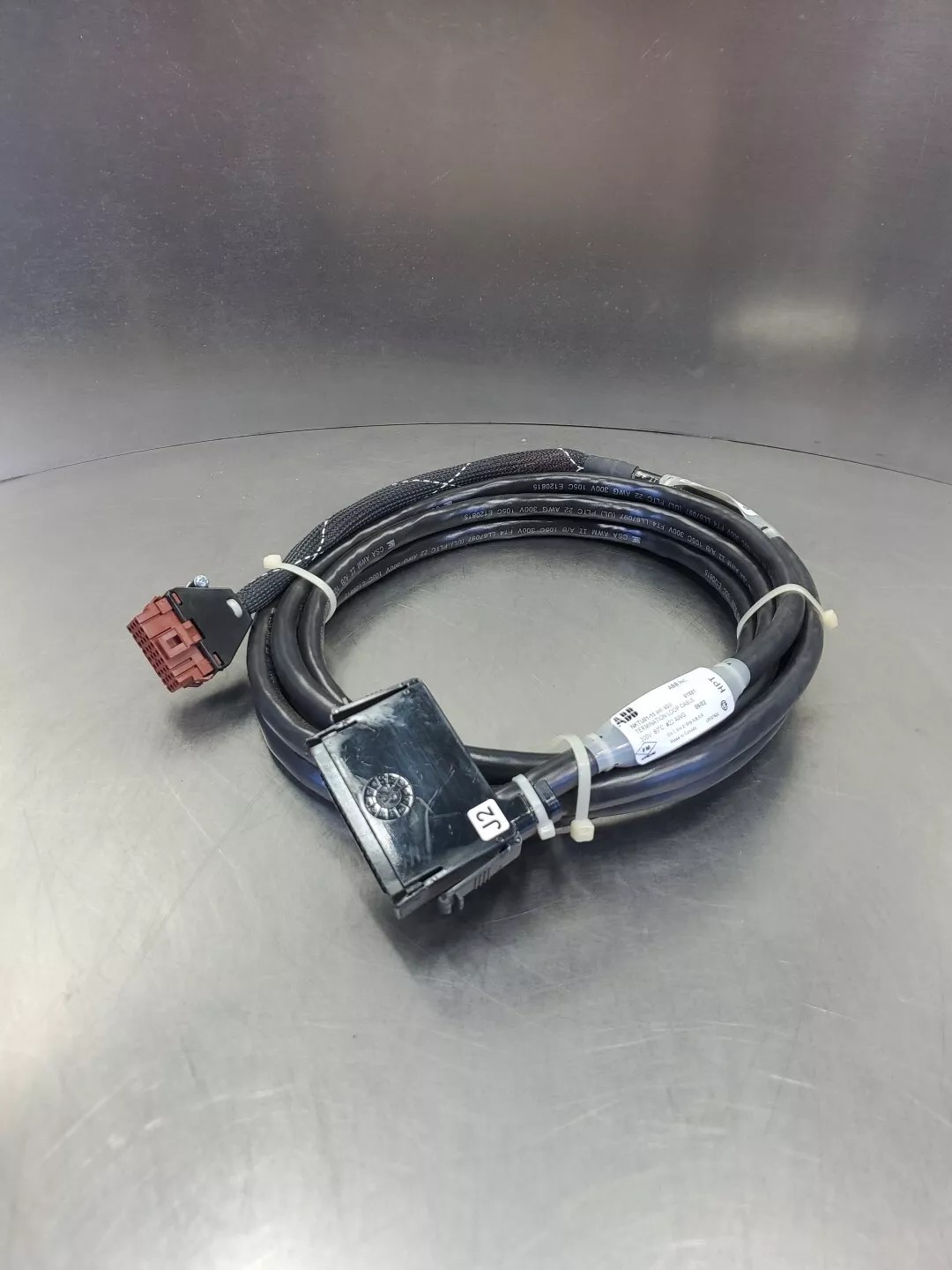
In modern industrial automation, the integrity of signal transmission between control modules, I/O devices, and field instruments is paramount. Distributed Control Systems (DCS) and Programmable Logic Controllers (PLC) depend on robust, interference-free connectivity to maintain process stability, equipment safety, and operational efficiency. The ABB NKCL01B-5 and NKCL02B-5 industrial control cables are engineered to meet these exacting demands—providing reliable, shielded signal transmission in some of the harshest industrial environments.
Product Overview
The NKCL01B-5 and NKCL02B-5 are part of ABB's extensive NKCL cable series, which is widely deployed in ABB Bailey INFI 90 and Harmony DCS systems, as well as in third-party PLC and control platforms. Both models feature a compact 5-foot (approximately 1.5-meter) length, making them ideal for localized connections within control cabinets, modular equipment racks, and short-distance module-to-module interconnects.
While both cables serve similar core functions, they are designed with distinct application profiles:
Feature
NKCL01B-5
NKCL02B-5
Primary Application
Standard control signal wiring
Analog control station / higher-frequency signal transmission
Typical Use Case
Module-to-module connections in control cabinets
PLC/DCS module signal interconnection
System Compatibility
ABB Bailey INFI 90, Harmony DCS, PLC systems
ABB Bailey systems, analog control stations
Key Technical Features
Superior Signal Integrity
Both cable variants utilize precision-engineered conductors and insulation layers to ensure stable signal transmission with minimal attenuation. The conductor construction typically employs stranded copper wire, which enhances flexibility and reduces the risk of breakage during installation and maintenance.
Robust EMI Shielding
Industrial environments are rife with electromagnetic interference (EMI) from motors, variable frequency drives, and switching power supplies. The NKCL01B-5 and NKCL02B-5 feature high-grade shielding that provides excellent protection against EMI—a critical requirement for maintaining signal quality in electrically noisy environments. This shielding ensures accurate data transmission and stable operation of sensitive control systems.
Durable Construction for Harsh Environments
These cables are built to withstand the rigors of industrial service:
Outer sheath: Abrasion-resistant material capable of withstanding mechanical friction, vibration, and light impacts
Insulation: Heat-resistant and corrosion-resistant materials that resist oil, moisture, and chemical exposure
Temperature tolerance: Designed for continuous operation across a wide temperature range typical of manufacturing and process industries
100-Ohm Impedance for Digital Communication
The NKCL cable series is optimized with 100-ohm impedance, a specification that makes it particularly well-suited for digital data transmission in industrial networks. This impedance matching minimizes signal reflections and ensures low-latency, robust communication even over extended network segments.
Applications and Use Cases
Control Cabinet and Module Interconnections
The compact 5-foot length of the NKCL01B-5 and NKCL02B-5 makes them the preferred choice for short-distance connections within control cabinets, between adjacent modules, and from modules to terminal boards. Their manageable size simplifies cable routing and reduces clutter in densely populated cabinets.
DCS and PLC Systems
These cables are extensively used in:
ABB Bailey INFI 90 and Harmony DCS installations
PLC systems requiring reliable I/O module connectivity
Analog control stations for process monitoring and control
Industry Verticals
ABB NKCL series cables find application across multiple industrial sectors:
Power generation: Monitoring equipment and control module connections in power plants
Petrochemical: Signal transmission in high-temperature, high-corrosion environments
Metallurgy: Automation生产线 control systems
Water treatment: Remote signal transmission for distributed monitoring points
Manufacturing: PLC-to-sensor and PLC-to-actuator connections on automated production lines
Installation and Handling Considerations
When deploying NKCL01B-5 and NKCL02B-5 cables, observe the following best practices:
Power isolation: Always disconnect system power before installing or replacing cables
Bend radius: Maintain appropriate bending radius to avoid sharp kinks that could damage conductors
Connector integrity: Ensure connectors are fully seated and secured to prevent signal intermittency
Periodic inspection: Regularly check cable sheathing for wear, cracks, or chemical damage
Cable management: Use cable trays, conduits, or bundling to protect cables from physical stress
Why Choose ABB NKCL01B-5 and NKCL02B-5?
Advantage
Benefit
Proven reliability
Backed by ABB's global reputation in industrial automation
EMI immunity
Maintains signal fidelity in electrically noisy environments
Industrial durability
Withstands temperature extremes, vibration, moisture, and chemicals
Flexible deployment
5-foot length ideal for cabinet and short-run applications
Broad compatibility
Works with ABB Bailey systems and standard PLC/DCS platforms
Conclusion
The ABB NKCL01B-5 and NKCL02B-5 industrial control cables deliver the signal integrity, electromagnetic immunity, and mechanical durability that modern automation systems demand. Whether you are upgrading an existing ABB Bailey DCS, expanding a PLC-based control system, or specifying cables for a new greenfield installation, these 5-foot shielded cables offer a reliable, field-proven solution for critical control and signal transmission applications.
For system integrators, maintenance engineers, and procurement specialists, the NKCL01B-5 and NKCL02B-5 represent a low-risk, high-performance choice—ensuring that the "last mile" of your control system connectivity performs as reliably as the logic and processing that precede it.
Powering Modern Industry: A Comprehensive Guide to ABB Bailey Cable Solutions In the world of industrial automation, energy distribution, and robust infrastructure, the quality and reliability of cable systems are non-negotiable. ABB Bailey stands at the forefront of this critical sector, engineering cables that deliver…
ABB Burry Cables: Complete Guide to NKAS, NKCL, NKDO, and NKDS Series ABB Burry cables are renowned worldwide for their reliability, durability, and high performance in industrial applications. This guide provides an in-depth overview of ABB Burry cable series, including NKAS01-15/10/20/25/30, NKAS11-15/10/20/25/30, NKCL01-15/20/25/30/50/100, NKCL01B-5, NKCL02B-5,…
ABB Burry Cables: High-Quality Industrial Power and Control Solutions ABB Burry cables are renowned for their reliability, durability, and high-performance in industrial environments. This comprehensive guide explores the full range of ABB cables, connectors, and panels, including models 1948509A5, 6637636A1-15/10/20/25/30, 6637818A1, 6638748A1, 6642335A1-15, 6CABLE-15, DIPSHUNT…